
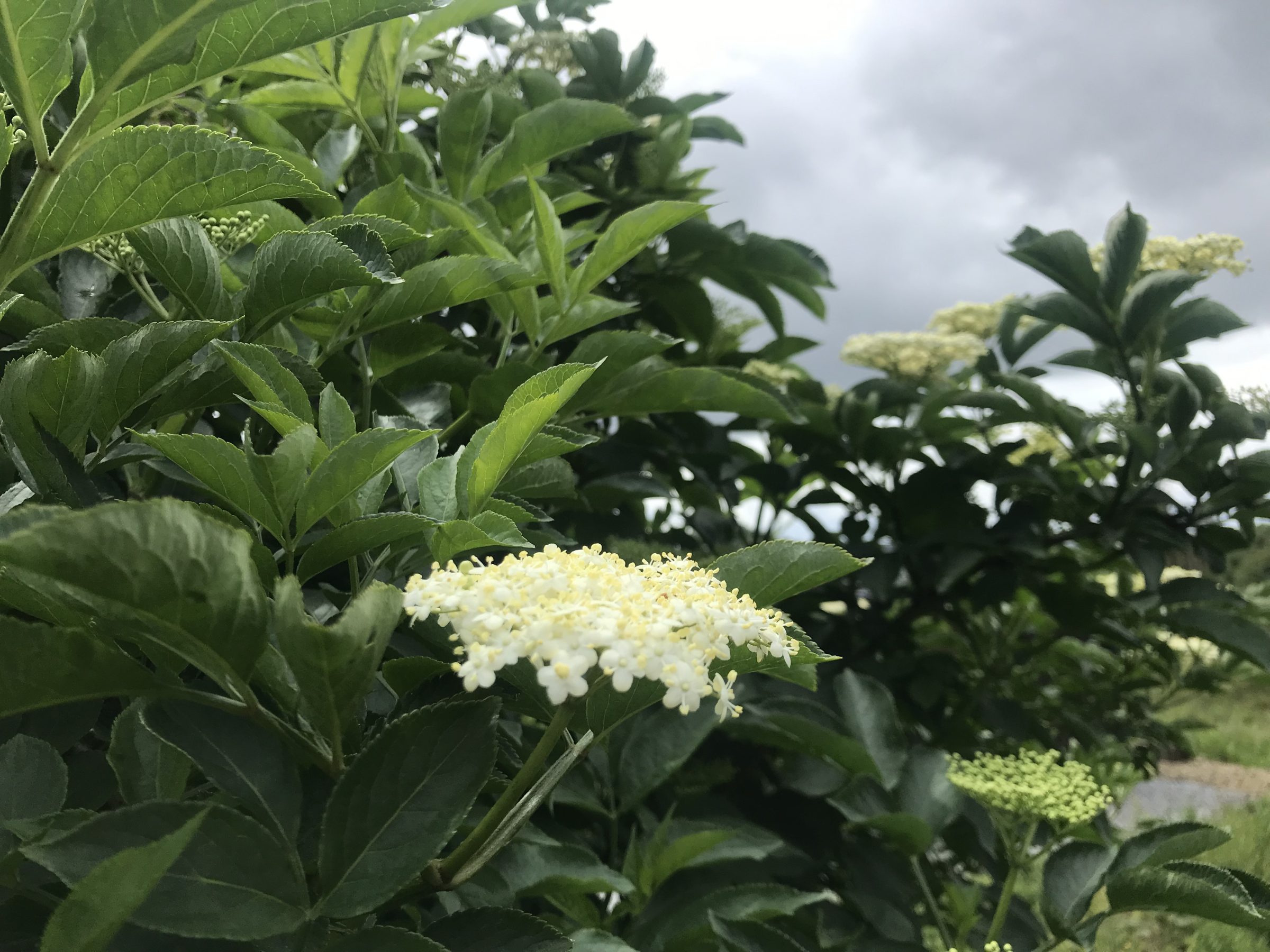
A plant that arrived on its own — and what it’s telling us
The Elder (Sambucus nigra) is flowering at Dronagiri right now. One of the trees is growing directly beside our sauna, and it arrived there entirely on its own. We never planted it.
We have planted over 3,000 native trees here since we began rewilding this land in 2019. Elder was one species we could never get to take — we tried several times without success. Over the past three years, however, four elder trees have appeared across the land by themselves, all self-seeded, all thriving. There is something in that worth paying attention to.
Trom — What the Irish Called It
In Irish, the elder is called Trom or Tromán. It holds the fifteenth letter of the Ogham alphabet — Ruis — and its place in that ancient tree alphabet speaks to how deeply embedded it was in Irish life. This was not simply a plant people used. It was a plant people understood.
In old Irish law, cutting down an elder was forbidden. It was considered a sacred tree, a boundary tree — something standing between the physical world and the Otherworld. Elder branches were hung over doorways and windows to ward off harm. It was associated with fairy lore in Ireland, Scotland and the Isle of Man, and regarded as a portal between realms.
At the same time, the folklore is characteristically layered. An old Irish saying warns:
“Trí comartha láthraig mallachtan: tromm, tradna, nenaid.” — Three tokens of a cursed site: elder, a corncrake, and nettles.
This sounds ominous, but there is a practical basis for it. Elder is a pioneer species — one of the first plants to colonise bare, disturbed, or recovering ground. Its seeds are carried in bird droppings and can germinate almost anywhere. To see elder arriving somewhere was a sign that the land was in flux. At Dronagiri, we take it as a sign that the land is beginning to recover. Which is exactly what we have been working towards.
Elder was known in Irish tradition as the medicine chest of the country folk. The flowers, berries, bark and leaves were all drawn on — from treating fevers, colds and congestion, to making cordials, wines, dyes, and skin preparations. One old belief held that a young woman who washed her face in the morning dew of elderflowers would remain young-looking. Whether or not that holds up, there is a reason elderflower still appears in quality skin preparations today. The anti-inflammatory and antioxidant properties of the flowers are well-documented.
Elder also had a ceremonial life in the Celtic calendar. At Beltaine, elderflower wine was drunk for blessing and protection. At Samhain, elderberry wine was used in divination rituals. The tree was believed to carry visions and to thin the boundary between what is seen and unseen. It was not a plant you harvested carelessly, but one you approached with respect.
The wood of elder has its own tradition too. The soft, pithy core of elder branches lends itself to making whistles, pipes and chanters — instruments central to Irish musical life. The name Trom itself may carry the weight of that history: something both heavy with meaning and generously useful.
The Ayurvedic View — Working with the Season

n Ayurveda, we do not look at a plant in isolation. We ask: what does this plant do, for whom, and at what time of year? Elderflower, understood through an Ayurvedic lens, is a plant that arrives precisely when it is needed most. (We are at a higher altitude so Elder flowers at a later time than at lower altitudes (Approx. 2-3weeks)
As we move into late spring and early summer, most people carry a residue of winter accumulation in the body. In Ayurvedic terms, this is excess Kapha — a heaviness and density that builds over the colder months. You may notice it as sluggishness, congestion, a thickness in the sinuses, puffiness, or a general lack of lightness. Alongside this, the increasing heat of the season begins to stir Pitta — and for some people, this manifests as hayfever, skin reactions, excess heat in the digestive system, or irritability.
Elderflower acts on both of these tendencies. It is a cooling herb, which helps to calm Pitta — reducing excess heat in the respiratory system and the skin. At the same time, it is cleansing and clearing, which addresses accumulated Kapha — opening the respiratory channels (the Pranavaha Srotas in Sanskrit), supporting lymphatic movement, and encouraging the body to let go of what has built up.
In Ayurveda, the respiratory channels are not simply anatomical structures. They are the pathways through which Prana — life energy — moves. When these channels are blocked or congested, the whole system feels it. Elderflower, by gently clearing these pathways, supports not just breathing but energy, clarity and vitality.
Elderflower also has a gentle action on Agni — the digestive fire. If your appetite has been low, if your digestion has felt sluggish or irregular, if elimination has been off, these are often signs that Kapha has accumulated in the digestive system too. A simple elderflower tea taken in the morning can help to kindle that fire gently, without aggravating it. Think of it as opening a window in the body after a long winter with the door shut.
The flowers are at their peak right now. The simplest way to use them is as a tea — a small handful of fresh flower heads, steeped in hot water for five minutes, then strained. Honey can be added if the digestion needs it. This can be taken once or twice daily during the flowering season. A cordial made from fresh flowers is another traditional preparation, and a pleasant one — though the sugar content means it is better used sparingly as medicine than freely as a drink.
A note on doshas: elderflower is generally best suited to Pitta and Kapha constitutions and imbalances. If you are primarily Vata — tending towards dryness, anxiety, lightness, or irregularity — elderflower is not necessarily your first herb. As always in Ayurveda, it is the individual that matters, not the herb alone. If you are unsure about your constitution or what your body needs right now, an Ayurvedic consultation is the place to start.
Elder Beside the Sauna — A Meeting of Traditions
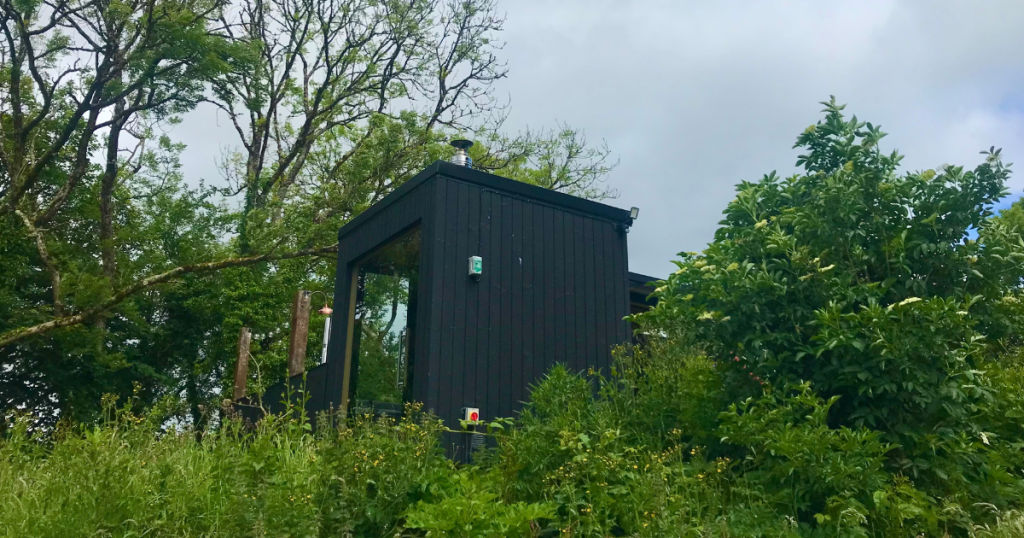
The fact that one of our self-seeded elder trees has appeared directly beside the sauna feels like more than coincidence.
In Ayurveda, heat therapy is known as Swedana — a practice of using steam, warmth and herbal infusions to open the pores of the skin, loosen accumulated toxins, and encourage the body to sweat. Sweating, in Ayurveda, is not merely a side effect of heat. It is one of the primary ways the body eliminates excess, particularly excess Kapha. The Charaka Samhita — one of the foundational Ayurvedic texts — describes sweating as essential to fat metabolism. As we mentioned in our piece on weight management, if you exercise but do not sweat, the road to elimination is a long one.
In the Nordic and Finnish sauna tradition, aromatic plants have always been part of the bathing ritual. The vihta or vasta — a bundle of fresh birch branches used to gently whisk the skin during a sauna session — is the most well-known example. The branches stimulate circulation, release aromatic compounds into the steam, and deepen the physical and sensory experience of the heat. Other plant traditions exist across Europe and the Baltic: oak for the skin, eucalyptus for the respiratory system, and various herbs added to the water poured over the stones.
Elderflower makes a great deal of sense in a sauna context. The volatile oils in the flowers — when released into steam by the heat — would carry their cooling, opening, respiratory-supportive properties directly into the air you are breathing. At a time of year when many people carry congestion or hayfever, sitting in a sauna gently infused with elderflower steam would work from two directions at once: the heat encouraging Kapha to move and the body to sweat, while the elderflower cools excess Pitta and opens the respiratory channels.
You can do this simply by placing a small bunch of fresh elderflower heads in a bowl of water beside the sauna stones, or by adding a light infusion to the water you pour over the stones. The result is a subtle, sweet, softly floral steam — nothing overpowering, just a quiet reminder of what is flowering a few steps away.
We are watching this tree carefully. It has placed itself well.
What Elder Tells Us About This Land

We did not plant these four elder trees. We tried to, and failed. They came on their own.
Since 2019 we have planted over 3,000 native trees here at Dronagiri — hawthorn, blackthorn, oak, ash, rowan, willow, alder and more. We have been rewilding the land, restoring hedgerows, creating habitats, pulling back from intensive management and allowing nature more room to move. It has been patient, sometimes slow work. But things are responding.
The arrival of self-seeded elder is, in ecological terms, a good sign. Elder is a pioneer — a species that moves into recovering land early, fixes nutrients, provides shelter and food for insects and birds, and prepares the ground for slower-growing species to follow. The creamy white flowers are alive with pollinators right now. Later in the autumn, the dark berries will bring in birds from across the hedgerows. The dense branching structure offers nesting cover throughout the year.
But beyond the ecology, there is something else. In Ayurveda — and in old Irish tradition — there is an understanding that a place has its own intelligence. That land which is cared for begins to care back. That when you work with nature rather than against it, unexpected things arrive. Sometimes the most valuable plants are the ones you did not plant yourself.
The elder arrived beside the sauna. It arrived along the boundary. It arrived in the hedgerow overlooking the cabins. Each one healthy, flowering, offering something.
We are inclined to trust that.
Come and see it yourself.
Our cabins sit within this landscape — close enough to walk these paths in the morning, to smell the elderflower on the air, to sit beside the sauna and watch the bees move through the blossoms. If you have been thinking about a few days away — somewhere quiet, somewhere that takes both nature and wellbeing seriously — we would love to have you.
Leave a Reply